
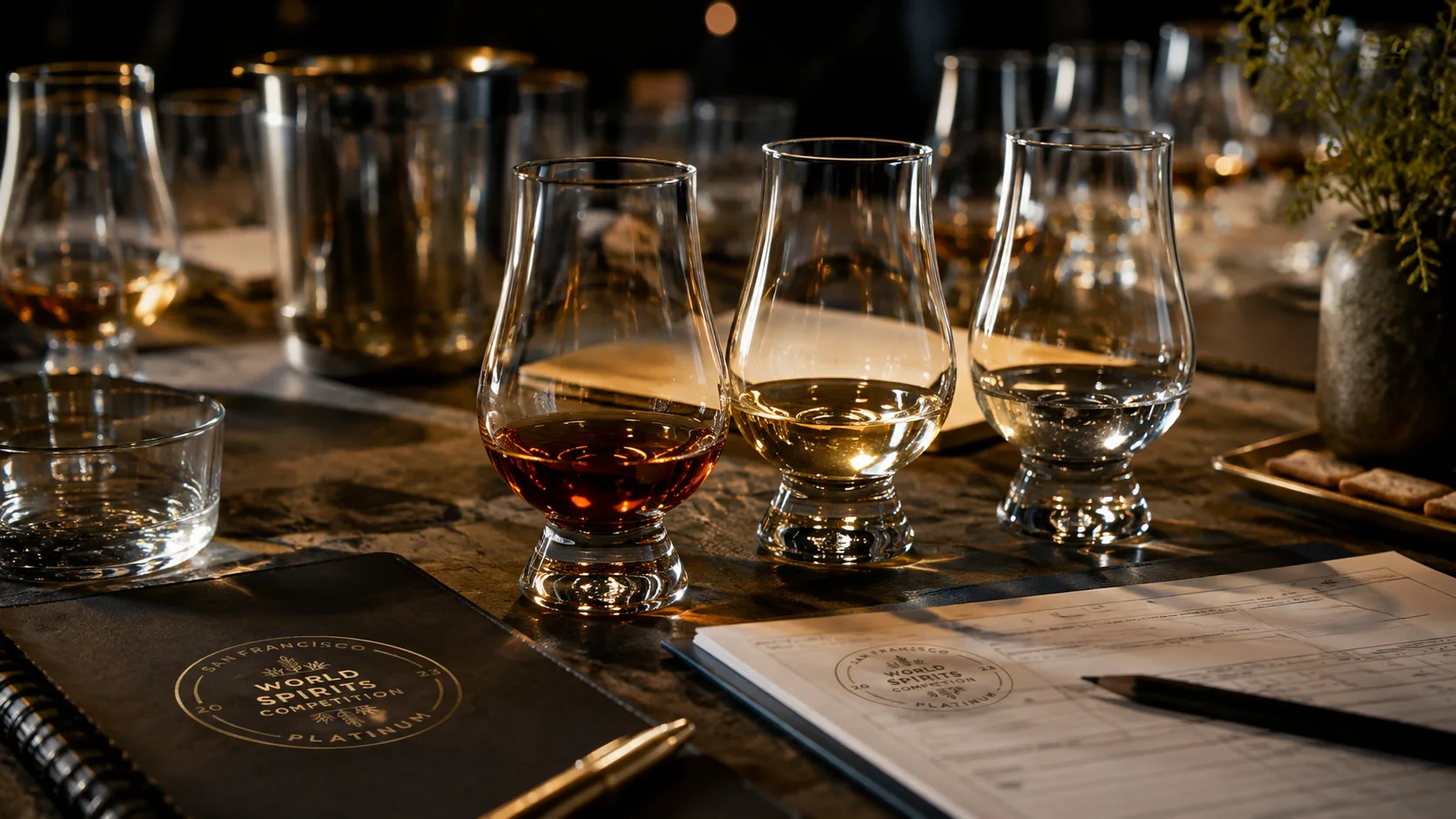
Curaçao rum with two Double Golds. Korean single malt competing with Taiwan and China. A debut Scotch making noise. The 2026 San Francisco World Spirits Competition is less interesting as a ranking than as a map of where drinks are going next.
The medals are in.
Not all the final crowns have been awarded yet, but the first results from the 2026 San Francisco World Spirits Competition are already giving us plenty to talk about.
And perhaps the most interesting thing isn't which famous bottle collected another medal. It's how wide the world of spirits is becoming.
This year's results move from Curaçao to Fife, from Kentucky to Toyama, from Taiwan to South Korea and China. Established producers sit alongside names most drinkers have never encountered before.
For Drinkzy, that's where an awards competition becomes interesting.
Not as a definitive answer to what is the best? But as a reason to ask:
What haven't we discovered yet?
First, a small distinction
The San Francisco World Spirits Competition is one of the longest-running international spirits competitions in the United States. Its judging is conducted blind, with products evaluated without branding or packaging influencing the tasting.
Gold is significant. Double Gold is harder.
For a spirit to receive Double Gold, every judge on its panel has to independently consider it worthy of Gold.
And then there is Platinum: recognition reserved for bottles that manage to earn Double Gold for three consecutive years.
But the 2026 story isn't finished.
While medals and several Best New awards have already been announced, many of the larger Best of Class titles will not be decided until the Top Shelf Awards in San Francisco on November 8, 2026.
So this isn't our final list of winners.Think of it as a watchlist.
And one name immediately stood out.
Curaçao enters the rum conversation
When most people think about drinks from Curaçao, rum probably isn't the first category that comes to mind. That may slowly be changing.
AnnaBay Club, based in Willemstad, entered three of its Curaçao-made rums into this year's competition.
All three returned with medals.
AnnaBay Club Amber Rum:Double Gold — 98 points
AnnaBay Club Aged 5YO Rum: Double Gold — 97 points
AnnaBay Club White Rum:Silver
Two Double Golds from three entries would be noteworthy anywhere.
For a producer trying to establish Curaçao as a serious rum origin, it means something more.
AnnaBay produces and bottles its rum at the St. AnnaBay Distillery in Willemstad, and the brand has been explicit about its ambition: to put Curaçao on the international rum map.
San Francisco just gave that ambition a considerable push. But there is another reason this story caught our attention.
Drinkzy users had already found AnnaBay.
Before we started researching this article, and without any involvement from the brand, AnnaBay had already been independently logged by Drinkzy users.
It is a small detail. But perhaps a more interesting one than it first appears.
A competition can tell people what judges discovered. A drinking journal tells you what people are discovering for themselves. Someone encountered AnnaBay. They remembered it. They logged it. And only later did we find ourselves looking at a 98-point Double Gold result from the same producer.
That's the kind of overlap we like.
Rum keeps refusing to stay where you expect it. AnnaBay wasn't the only rum result worth noticing.
BACARDÍ Gran Reserva Diez scored 98 points and Double Gold, showing that established names can still make serious competition noise. Then there is a considerably stranger geographical story.
Original Islay Rum Barrel Aged also scored 98 points and Double Gold.
Yes. Islay. The Scottish island synonymous with heavily peated whisky is now appearing on a major international awards list for rum.
The spirit is matured in barrels previously used for Islay whisky, bringing two drinking traditions together in a way that would have sounded unusual not long ago.
That contrast tells us something.
The old map of spirits — Scotch comes from Scotland, rum comes from the Caribbean, tequila comes from Mexico, bourbon comes from Kentucky — is increasingly too simple. Origins still matter.
But categories are travelling.Techniques are travelling. Ideas are travelling. And drinkers increasingly get to discover the results.
A debut Scotch walks into San Francisco
Scotland supplied one of the more interesting new-name stories of the competition.
KinGlassie Double Matured Aged 8 Years Fife Single Malt Scotch was named Best New Scotch.
The whisky comes from InchDairnie Distillery in Fife. What makes the award particularly interesting is that KinGlassie represents the distillery's first single malt release under the name.
Scotch is a category where heritage carries enormous weight.
Age statements, historic distilleries, old warehouses, generations of provenance — the category knows how to tell a story about time. And then a new bottle arrives.
No century-old reputation. No famous label required in the judging room. Just the liquid. And it wins Best New Scotch.
That's what blind tasting can occasionally do well: strip away the story long enough to let a new one begin.
Japan turns the peat up
Japan produced another of the confirmed Best New winners. Saburomaru V The Hierophant Cask Strength was named Best New Japanese Whisky. This isn't the delicate image of Japanese whisky some drinkers may expect. The whisky is heavily peated. It comes from Saburomaru Distillery in Toyama. And at 60% ABV, it isn't exactly trying to whisper.
Japanese whisky has spent years establishing itself internationally through precision, rarity and increasingly expensive prestige bottles. Saburomaru represents another side of that category. More smoke. More intensity. A very distinctive identity.
Another reason not to reduce an entire country's whisky to one flavour profile.
The whisky map is moving east
The finalists for Best Other Single Malt Whisky might be one of the clearest signs of where the category is going.
The six finalists come from: Taiwan, South Korea. China. Taiwanese producer Kavalan has two Solist expressions among the contenders. South Korea's Ki One appears three times, with Star, Tiger Cask Strength and Sun. China is represented by Laizhou Bourbon Cask Peated Single Malt Whisky.
Read that list again. Not Scotland. Not Ireland. Not Japan. Not the United States.
That isn't a criticism of traditional whisky countries. It's evidence that the category has become much larger than them.
Twenty years ago, many casual drinkers would have struggled with the idea of world-class whisky from Taiwan.
Kavalan changed that conversation.
South Korea and China may now be entering their own version of it.
The Best of Class winner still has to be announced. But in some ways, the shortlist is already the story.
Meanwhile, bourbon has the opposite problem
If newer whisky regions are fighting to be noticed, bourbon is dealing with an abundance of attention.
More than 550 bourbons were evaluated during this year's competition.
Five hundred and fifty.
At that scale, simply asking for "the best bourbon" stops being particularly useful.
So the competition breaks the category apart. Small Batch. Single Barrel.
Wheated Bourbon. Age ranges. Finished expressions. Different production styles. Different proof points. Different intentions.
Among the confirmed new winners, Fathertime Bourbon — The Caboose: Empty Nester Strength was named Best New Bourbon. The brand itself only launched in 2024.
Again, a relatively young name standing out in one of the most crowded spirits categories in the world.
And then there are the bottles that keep winning
Novelty is fun. Consistency is harder.
That's why the Platinum results deserve a different kind of attention.
To earn Platinum at SFWSC, a product has to receive Double Gold for three consecutive years. Among this year's Platinum recipients are some serious names:
Blanton's Straight from the Barrel
Eagle Rare Straight Bourbon
Redbreast 12 Year Old Cask Strength
Redbreast 27 Year Old
Yellow Spot
Ardbeg 25
The Glendronach 18
Tequila Ocho Plata
Tanqueray London Dry
Tanqueray No. TEN
Kavalan Solist Fino Sherry
Rum's Platinum list is considerably shorter.
Just two expressions made it:
Calazan Ron Añejo Reserva andCotton & Reed White Rum
Platinum doesn't necessarily tell us what's newest. It tells us which bottles have been able to return to the same judging environment year after year and keep performing. That's a different achievement. And arguably a more difficult one.
So what actually won SFWSC 2026?
Right now, there isn't one simple answer.
Hundreds of spirits have won medals.
Several Best New titles have been decided.
Double Gold and Platinum recipients are known. But many Best of Class winners are still waiting for November. And perhaps that's a good thing. Because collapsing a competition of this size into one headline bottle would miss most of what makes the results interesting. Look beneath the rankings and something else appears.
A small rum producer from Curaçao walks away with 98 and 97 points.
A first-release Scotch wins its new category. A 60% ABV heavily peated Japanese whisky takes another. South Korean whisky occupies half a major single malt shortlist. Chinese whisky is on it too.
An Islay producer gets Double Gold for rum. And more than 550 bourbons compete in one year alone. That's not one winner. That's an industry moving in several directions at once.
The bottle we're watching: AnnaBay
Every competition produces famous names. We're more interested in the names you might remember for the first time.
For us, one of those names from SFWSC 2026 is AnnaBay Club. Not simply because 98 points looks impressive on paper.
Not simply because it took home two Double Gold medals. And not because an award suddenly makes a bottle worth discovering. It's the combination that makes the story interesting.
A producer in Willemstad is trying to create a stronger identity for rum made in Curaçao. International judges have now recognised two of those rums at Double Gold level.
And independently, Drinkzy users had already started logging AnnaBay before we ever went looking for this story.
That's discovery happening from two directions. The industry notices. Drinkers notice. Eventually, a place that wasn't previously part of someone's mental map of rum starts appearing on it.
Curaçao is on ours now.
What's next?
The 2026 competition isn't finished.
The remaining Best of Class winners will be revealed during the Top Shelf Awards in San Francisco on November 8.
We'll return to the results when those final titles are announced. But until then, there is already enough here to do what we think an awards list should actually do:
Not tell you what you're supposed to drink.
Give you something new to discover.
Keep track of what you discover.
Build your personal drink journal on Drinkzy.
Drinkzy covers drinks through discovery, provenance and the stories behind what people choose to remember. Awards are referenced as editorial context and are not an encouragement to consume alcohol.
Comments