
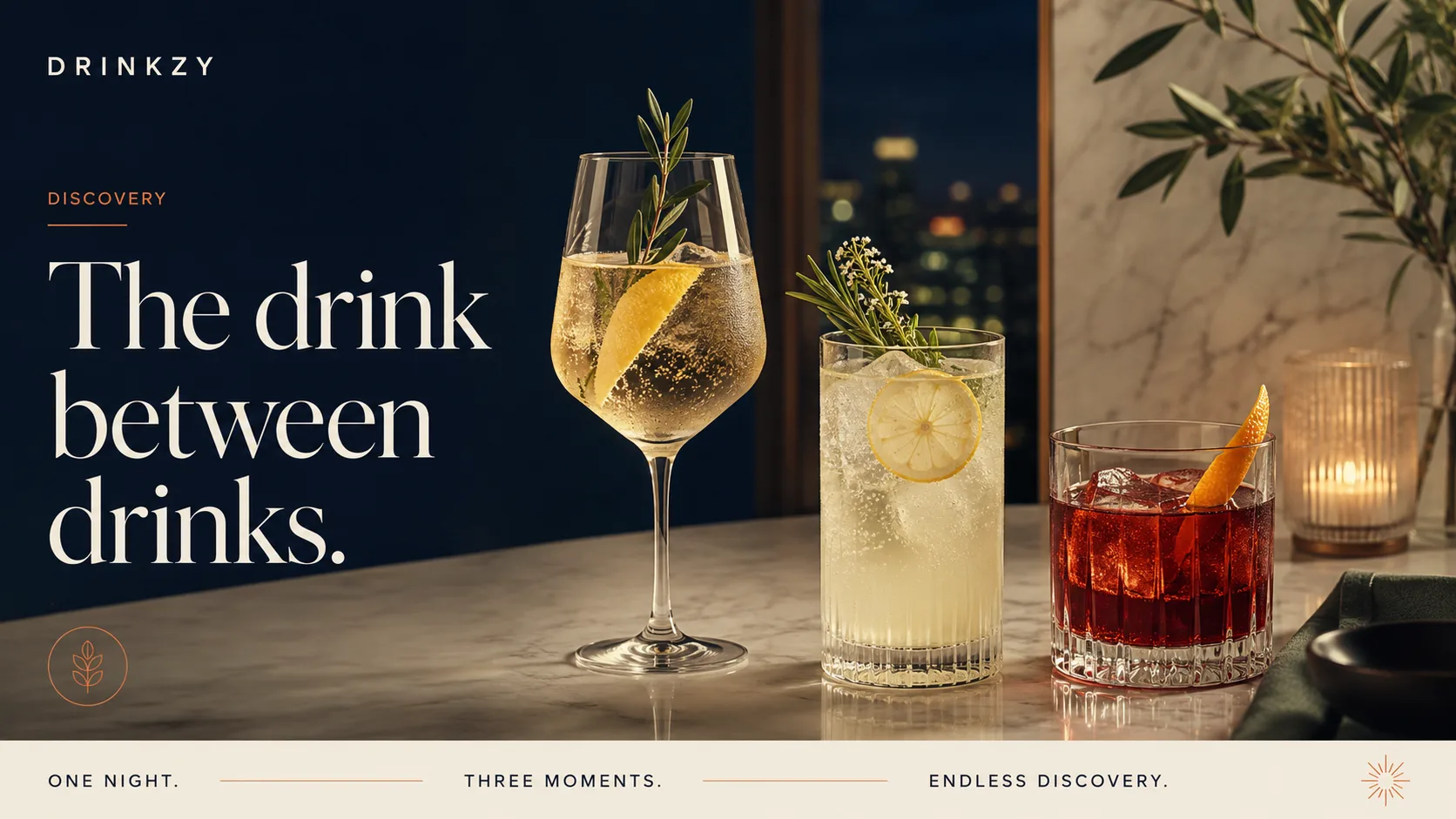
The most interesting thing happening in drink culture right now isn't a new spirit or a cocktail trend. It's what people are reaching for in between.
Picture a Friday evening. Someone starts with a glass of wine. Then reaches for a sparkling water with a dash of bitters. Then a beer. Then something alcohol-free — a kombucha, a botanical soda, something they picked up because it looked interesting. Then maybe one more wine.
This is how a lot of people actually drink now. Not one category, all evening. Not a decision to abstain. Just a natural movement between things depending on how they feel, how hungry they are, how the conversation is going.
Most drinks apps have no language for this. They're built for people who drink one way — wine people, beer people, spirits people. The drink between drinks just disappears from the record entirely.
What's changing
Non-alcoholic doesn't mean what it used to
For a long time, choosing a non-alcoholic drink in a social setting meant choosing the absence of something. The options communicated that absence clearly: a soft drink, a juice, tap water. Nothing that felt like it belonged next to a Negroni.
That's shifted considerably. Between 2022 and 2024, the no-alcohol segment recruited an estimated 61 million new drinkers worldwide — and most of them are regular drinkers who now reach for a zero-proof option on a Tuesday and a full-strength pour on Saturday.
The non-alcoholic drink is no longer positioned as a substitute. It's increasingly its own thing — with its own flavour complexity, its own occasion logic, its own place in an evening.
The most interesting drinkers right now aren't choosing between alcohol and no alcohol. They're choosing both, in the same evening, for different reasons at different moments.
Zero-proof spirits, premium mocktails, prebiotic sodas, kombucha, fermented drinks — the category is no longer about absence. It's about sensory complexity: bitter botanicals, tannin, length, the markers that signal something worth paying attention to.
The question being asked of these drinks is the same question asked of any drink worth logging: what does it actually taste like?
Why this matters for your journal
The whole evening is the record
If you only log the alcoholic drinks in a given evening, you're keeping half a record. The drink you had in between — the one that felt right at that moment, that gave you something different, that you'd either reach for again or skip entirely — that belongs in your journal too.
Consider what an evening's full log actually looks like:
7:00 PM Aperol Spritz
Light, easy, good start to the evening Alcoholic
8:15 PM Botanical soda — ginger & yuzu
Sharp, really interesting. Would have again. Zero-proof
9:30 PM Negroni
Bitter, deep, exactly what I wanted after dinner Alcoholic
The botanical soda in the middle isn't a gap in the evening — it's a data point. It tells you something about what you were looking for at that moment: something complex and interesting that wasn't alcohol. That's a preference worth knowing.
And the honest observation is this: the most curious drinkers — the ones who pay attention to what they're drinking and why — have always moved between categories. The no/low category just makes that movement more visible, more intentional, and more worth tracking.
Your whole drinking life includes everything you reach for. The glass of water that was actually a sparkling botanical. The kombucha you ordered because nothing else on the menu looked interesting. The zero-proof aperitif that turned out to be the best thing you had all evening.
Comments