The Dutch drinks you'll be handed — and forget the name of by Monday
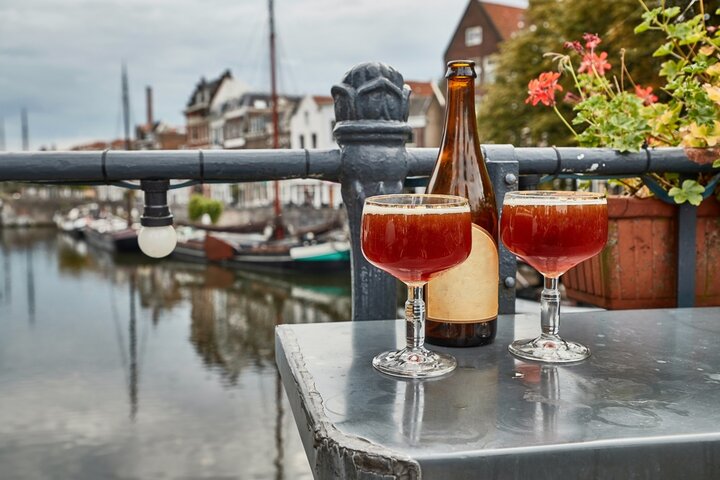
Someone hands you a tiny tulip glass, filled so high the liquid sits above the rim. Everyone around you is grinning. You're told not to pick it up. You lean in, take the first sip with your hands behind your back, and the whole table cheers.
Three days later a friend asks what it was. You remember the glass. You remember the laugh. You remember it tasted a bit like bread and a bit like gin. The name? Gone.
That gap, between the moment and the name, is exactly what a drink journal is for. So here's a short guide to the drinks you'll probably be handed in the Netherlands, and for each one, the few words worth writing down.
Why you remember the feeling but not the name
There's a reason one sip can pull you straight back to a specific evening years later. Smell does most of the work when you taste, and it has a shortcut in the brain: it lands almost directly in the parts that handle emotion and memory. Sight and sound take the long way round.
The name, meanwhile, is just a word someone said over the music.
So your brain keeps the warm, vivid part — the people, the mood, the taste — and quietly drops the label. Which is lovely, right up until you want to order it again.
1. Jenever: the grandparent of gin
Jenever is the Dutch juniper spirit that gin grew out of, and it's been protected by the EU as a regional product since 2008. You'll see two words on the bottle, and they're not what you think:
- Jonge (young) isn't younger. It's the newer, lighter style: by definition no more than 15% malt wine and 10 grams of sugar per litre. Crisp, clean, usually served ice cold.
- Oude (old) isn't older either. It's the old recipe, richer in malt wine, rounder and more aromatic.
If you lean toward a crisp vodka-and-tonic kind of evening, start with jonge. If you're the person who ends up talking about whisky, ask for oude. Either way, write jonge or oude in your note. It's the one word that tells future-you which one you actually liked.
2. The kopstootje: a ritual, not a race
That brimming tulip glass from the opening? That's the kopstootje, the "little headbutt": a glass of jenever with a beer alongside. Tradition says the glass is filled to the brim and you take the first sip by bowing down to it, hands off. After that, sip the jenever and the beer at your own pace.
It's a ritual about the moment, not the volume. One is the whole experience. And note the beer too: the pairing is half of what made it work.
3. The straaljager: jenever goes long
Not a neat-spirit person? A straaljager is jenever topped with bitter lemon. It's an easy way into the flavour if you'd rather have something tall and fizzy, and it's the drink that tends to surprise people who said they "don't like jenever."
4. The beer list that isn't pils
The default pour at most Dutch bars is a small pils, served quickly with a firm head of foam. But many menus also have a separate list of speciaalbier, the specialty beers. If you like discovering things, that's the list to read slowly. When one lands, write down the style as well as the name. The style is what you'll actually be able to order again somewhere else.
5. The zero-proof pour
Alcohol-free options are a normal part of a Dutch borrel now: 0.0 beers, alcohol-free spritzes, the works. They belong in your taste history as much as anything else. Some of the best "what was that?" moments come out of the glass with no alcohol in it.
The two-cue trick for keeping the good ones
Memory works best when you give it hooks. When something lands for you, take ten seconds and capture two cues while it's still in the glass:
- What it reminded you of. "Bread and juniper." "Like a lemony tonic." Your own words beat a perfect tasting note.
- Where you were, and with whom. The bar, the occasion, the friend who ordered it.
Those two cues are what bring the evening back later, and the name tends to come with them. The second one matters more than it looks. It's the same reason the same drink tastes different on different nights.
Keep the ones you liked
That's what Drinkzy is for: one journal for every kind of drink, from jenever and speciaalbier to a glass of wine or a zero-proof spritz, with room for the photo, the occasion and the note in your own words. And in Sip Society you can see what other sippers are pouring, which is often how the next good discovery finds you.
Had one of these recently, or one you still half-remember from a borrel? Log your first Dutch drink on Drinkzy →