
Ice doesn't just cool your drink. Here's what it actually does.
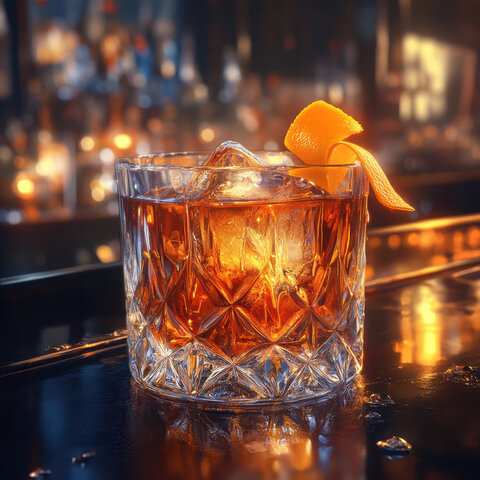
Washington State University researchers ran a blind tasting in 2023 with six whiskies — three Scotch, three bourbon. Tasters could tell them apart when they were neat. Once the water content passed roughly 20%, the whiskies started smelling almost identical. One large ice cube, the researchers noted, can get you to exactly that point.
Two things happening at once
Ice cools the liquid and melts into it. These two effects work against each other and interact differently depending on what's in the glass. The temperature slows down what your nose and tongue pick up. The meltwater shifts the chemistry of the drink itself.
Which effect dominates depends on what you're drinking and how long the drink sits.
The dilution side
For spirits, a small amount of water is often useful. Adding it to a cask-strength whisky releases aromatic compounds that are harder to reach at higher alcohol concentrations. In the WSU study — led by assistant professor Tom Collins and researcher Elizabeth Tomasino of Oregon State — the smoky compounds in Scotch dropped off as water was added, and fruitier aromas came forward. American bourbons gained corn and grain notes that were less obvious neat.
This is why bartenders sometimes add a few drops of water to a neat pour at the table. Those drops bring out aromas the alcohol was muting.
Where it goes wrong is too much. The WSU researchers found that above 20% water, the whiskies started converging — the things that made each one distinct started to flatten out. A large ice cube keeps you in the useful range: enough water to open the spirit up, melting slowly enough not to overshoot.
Why size and shape matter
Ice melts at its surface. A larger piece has less surface area relative to its volume than several smaller pieces adding up to the same weight, so it melts more slowly.
This is why Japanese whisky bars take ice seriously. A Suntory highball in Tokyo is often built around a single large block of clear ice, hand-cut to fit the glass. The slow melt keeps the drink cold without diluting it past the point where the whisky stops tasting like itself. Standard bar crescent ice has a lot of surface area and melts fast. For anything you plan to drink slowly — a good whisky, an aged rum, an amaro — the size of your ice determines how much time you have before the drink changes significantly.
What cold does to how you taste
Cold slows flavors down. A white wine poured straight from the fridge tends to seem flat at first and gets more interesting as it warms in the glass. The flavor doesn't change, but your ability to perceive it does.
CO2 dissolves more readily in cold liquid and escapes as it warms, which is why a cold sparkling water feels more lively than the same water at room temperature, and why Champagne that's been sitting in a warm room goes flat faster.
Bitterness is perceived as more intense when drinks are cold. A 2012 study published in Chemosensory Perception tested 74 people and found that cold temperatures amplified bitter perception. For beer drinkers, this matters. Most craft beer is intended to be served at cellar temperature — somewhere between 8 and 13°C depending on the style. Most bar fridges run at 1–3°C, colder than most styles call for, and at that temperature the bitterness reads higher than the brewer intended.
Across the glass
Cocktails are shaken or stirred with ice, then strained. The ice does its work during mixing — chilling and diluting — then leaves. A properly stirred cocktail and a rushed one can taste different even from the same recipe, and the ice contact time is usually why.
Red wine is usually served too warm and white wine too cold. A full-bodied red at room temperature in a warm restaurant loses structure; at around 16–18°C the tannins integrate better. A white that's been in the fridge for two days, poured straight, tends to be hiding most of what's interesting about it.
Cold brew coffee is not the same as hot coffee cooled over ice. The extraction happens at a lower temperature over a longer time, producing a less acidic, less bitter result. The ice just dilutes it — fast, if the cubes are small.
What to put in your Drinkzy log
The serving condition is worth writing down: neat, on the rocks, over one large cube, with a splash of water added. The same whisky over standard bar ice and over a single large sphere will give you two different sets of notes. Log both and you'll see the pattern.
Log how it was served. The details add up.